The Pigeoncote Bookstore
Medical Pigeon Books


| Menu | |
| Antique (prior to 1930) | |
| o | Authors: a-h |
| o | Authors: i-z |
| Dovecote | |
| o | Authors: a-z |
| Doves | |
| o | All authors |
| Breed Specific | |
| o | Racing homers |
| o | Pigeons in wars |
| o | Other breeds |
| Curios | |
| o | All items |
| Fiction | |
| o | Authors: a-h |
| o | Authors: i-z |
| Foreign Language | |
| Non English | |
| General Interest | |
| o | Authors: a-h |
| o | Authors: i-z |
| Magazines | |
| o | APJ |
| o | Pigeon Debut |
| o | Pigeon Fancier |
| o | Purebred Pigeon |
| o | The Fancier |
| o | feathered World |
| o | Others English |
| o | Foreign |
| Medical - Genetic | |
| o | Authors: a-z |
| Miscellaneous | |
| o | All others |

| Behavioral Effects of Electrical Stimulation in the Forebrain of the Pigeon Bengt Akerman |
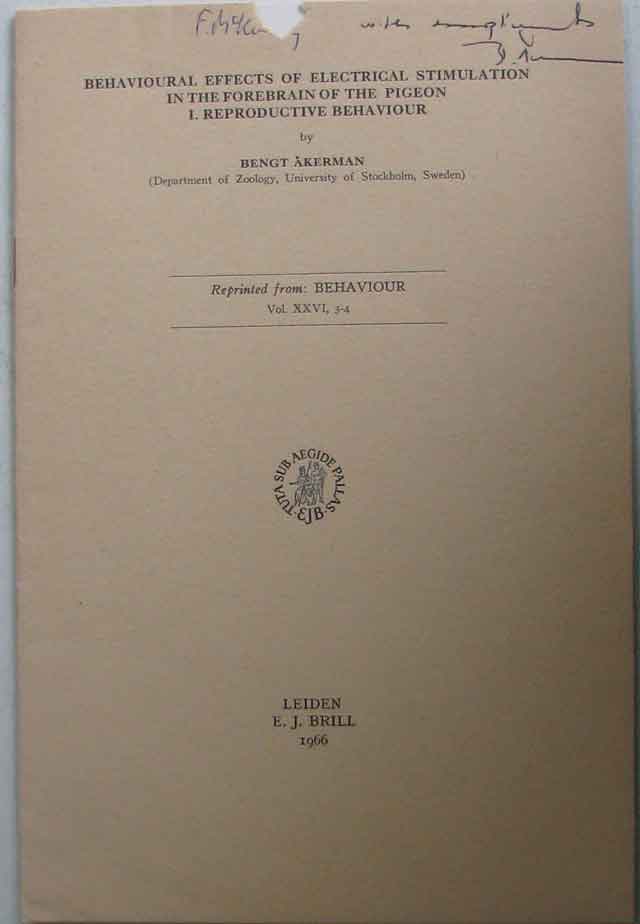 Originally published in 1965, in Behaviour, this rather specific
work done at the University of Stockholm was reprinted in 1966. It is absolutely a purely
academic work, that any pigeon breeder will fully understand and appreciate. After all,
we know about bowing, preening, aggression and ah yes, love. Originally published in 1965, in Behaviour, this rather specific
work done at the University of Stockholm was reprinted in 1966. It is absolutely a purely
academic work, that any pigeon breeder will fully understand and appreciate. After all,
we know about bowing, preening, aggression and ah yes, love. |
Experiments in Psychology Donald Blough & Patricia McBride Blough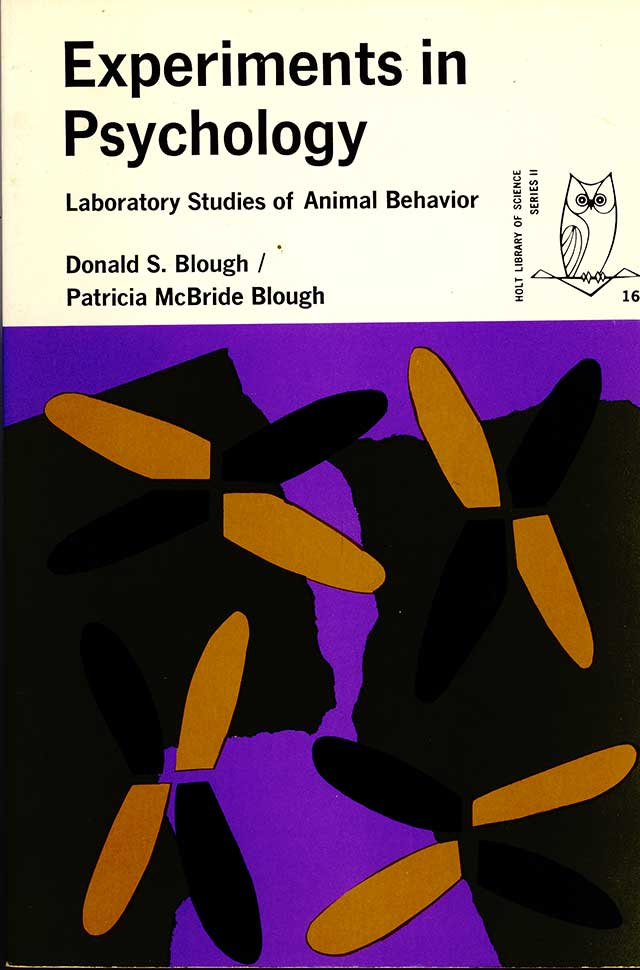 Excellent,
near mint, for its age. A book detailing many experiments about how animals behave, including several sections
on pigeons and how they learn and understand. Paperback published in 1964 of 160 pages. Excellent,
near mint, for its age. A book detailing many experiments about how animals behave, including several sections
on pigeons and how they learn and understand. Paperback published in 1964 of 160 pages. |
From Pigeons to People; Elizabeth Hall
From Pigeons to People displays the same clarity of thinking, readability, and accuracy that caused Why We Do What We Do to receive an Honorable Mention in the book' category of the 1974 National Media Awards of The American Psychological Foundation. 1974 National Media Awards of the American Psychological Foundation, Honorable Mention. "A straightforward, holding introduction to areas studied in modern psychology." Booklist "A very good overview of psychological processes and animal behavior clarified by descriptions of experimental research . . . includes chapters on motivation, emotions, learning, memory, thinking, and personality." "Lively, lucid, and learnable." Journal of Biological Psychology. |
A Veterinary Approach to Pigeon Health: Dr. David Marx DVM  David applies very hands on practical approach to keeping
pigeons healthy first and deals directly with the issues, symptoms, practices
and medications that are helpful in alleviating any issues that arise, including
some that are not considered as medical issues in some texts such as fertility.
While one would assume that a book of 212 pages dealing with pigeon health
would have to have a fair amount of fluff, one would be wrong. It is
comprehensive. An example of the thoroughness is the chapter on injuries
that explains when to use glues rather than stitches. While this and many
other chapters could be used by any bird fancier, A Veterinary Approach to
Pigeon Health, is targeted directly at pigeons, and scores a bull's eye. David applies very hands on practical approach to keeping
pigeons healthy first and deals directly with the issues, symptoms, practices
and medications that are helpful in alleviating any issues that arise, including
some that are not considered as medical issues in some texts such as fertility.
While one would assume that a book of 212 pages dealing with pigeon health
would have to have a fair amount of fluff, one would be wrong. It is
comprehensive. An example of the thoroughness is the chapter on injuries
that explains when to use glues rather than stitches. While this and many
other chapters could be used by any bird fancier, A Veterinary Approach to
Pigeon Health, is targeted directly at pigeons, and scores a bull's eye. |
| Color Breeding in Pigeon Plumage: Dr. J. Metzelaar | ||||
 |
 |
 |
This pioneering work that set the stage for future work in pigeon genetics. 1926 55 pages. | |
 |
Download as a free text seachable PDF file. |
|||
Intensive Line Breeding: M.H. "Dad" Paget Line breeding is and has been used by those in the know to establish a breed or strain in domestic animals of all
types. Dad Paget as he was known was one of the experts in his field and describes how to use this breeding method
to set the qualities you desire for you strain.. This pamphlet was originally published in 1949. This is a mint
reprint of that printing. Line breeding is and has been used by those in the know to establish a breed or strain in domestic animals of all
types. Dad Paget as he was known was one of the experts in his field and describes how to use this breeding method
to set the qualities you desire for you strain.. This pamphlet was originally published in 1949. This is a mint
reprint of that printing. |
|
|
Download as a free text seachable PDF file. |
Endocrines and Constitution in Doves and Pigeons: Oscar Riddle
Both copies are in very good to excellent condition. The softcover copy does have Dr. Herbert M. Evans' stamp on the title page as can be seen on the enlarged scan. |
Animal Orientation and Navigation: Robert Storm Editor The proceedings of the twenty-seventh annual biology colloquium of 1966 was published in 1997 by Oregon State University Press. While not directly dealing with pigeons, it certainly covers a topic anyone familiar with homing ability will find interesting. Nice little hardback publication covering the subject in134 pages. The covers are very good, but the interior is showing its age and there are some old marking on the front end papers.. The proceedings of the twenty-seventh annual biology colloquium of 1966 was published in 1997 by Oregon State University Press. While not directly dealing with pigeons, it certainly covers a topic anyone familiar with homing ability will find interesting. Nice little hardback publication covering the subject in134 pages. The covers are very good, but the interior is showing its age and there are some old marking on the front end papers.. |
Diseases of Pigeons: Various Authorities |
|||
 |
 |
 |
While the Diseases of Pigeons is attributed the various
authors, it is mainly drawn from J.W. Dietz's work dating back to 1919. A free searchable copy of this original work is available here for download. This
booklet was originally published by Chas Siegel & Son, a popular pigeon
supply house, in 1951 with the numerous changes that such a span of time
would dictate in the field of medicine and disease. This issue, an again
updated version, was printed in in1961. I am not sure if further updates
were ever provided.
After a brief introduction of the bird's physiology, it is very logically divided by the main type of diseases, including protozoan, bacterial, viral, fungi, parasites and more. This very rare manual is more for the understanding of the history of pigeon health in general than for today's application. While many of the treatments would with today's knowledge in the field not be apt, it does make one wonder what will be said of today's methods and practices a half century from now. Its very rarity places it on the list of the avid pigeon book collector. |
| Strickberger Genetics; Monroe W. Strickberger | |
 |
Very good reference book about genetics for those that wish to learn beyond just the genes relating to pigeons. This is a very large book of 868 pages |
Pigeon Health and Disease; David C. Tudor |
|
 |
Research conducted during the past several years has materially advanced
our knowledge and understanding of pigeon health and disease. The object
of this text is to provide pigeon fanciers, attendant veterinarians, and
research-oriented groups with factual information concerning pigeon diseases.
The text is organized to permit a clear understanding of each disease entity
together with present-day methods of control and/or prevention. Other basic
information on pigeon breeding is included to broaden the scope of the text.
The material presented is derived from the author's practical farm experience in earlier years, private practice, and day-to-day activities in the Avian Diagnostic Laboratory at Cook College, Rutgers University, where he served for 27 years as a research professor and teacher. Invaluable observations of other research personnel are included and documented to enhance the complete understanding of each subject. Additional un-cited references have been included to provide the reader with related information. The text is divided into five parts. The subheading format permits a complete discussion of each disease. References listed after each section enable further research on the part of interested investigators. Appendixes listing pathological and anatomical disease conditions, a glossary, and an index provide additional access to the terminology and disease information. The author wishes to express his deepest gratitude for the unlimited help and encouragement given by his wife, Emily. Artwork has been contributed by his daughter, Diane Louis. Inspiration for the publication stems from the memories of untiring efforts of devoted and loving parents and from the kindly and instructive suggestions of mentors F. R. Beaudette and C. B. Hudson. Published by Iowa State Univ |
| Keep Your Pigeons Flying: Leon F. Whitney | ||
 |
Leon Whitney's Keep Your Pigeons Flying is one of the first English language books that deal almost exclusively with the health and maintenance of pigeons. While he is a veterinarian, it is written in plain English with many drawings, diagrams and photographs to assist in clarifying the issue at hand. The first issue was published in 1961 at a time when some of the first good drugs became available. Some of the drugs are still in use, while others such as DDT have been removed. It seems obvious now that the best avenue against disease is prevention, and here is one area the book still shines bright. Chapters include the body, food, drugs, diseases by bacteria, viruses, fungi, protozoa, deficiency, parasites both internal and external, surgery, sanitation, enemies, and public health. An asset to any pigeon provider's library. | |
| Mini Dissection Guide to the Pigeon; Don Sherwood | |
 |
This mini guide was produced by Fisher Scientific and has a copyright of 1993 |
| Functional Morphology of the Tail Apparatus of the Pigeon; Julian J. Baumel | |
 |
115pp paperback |
| Laboratory Anatomy of the Pigeon: Robert B. Chiasson | ||
 |
Chiasson's Laboratory Anatomy of the Pigeon tells and shows the in and outs of the pigeon. Well more the ins than the outs, but one chapter is devoted to external anatomy and the Skin. Other chapters include the skeletal, muscular, digestive, respiratory, circulatory, urogenital, nervous, systems and special sense organs. Many diagrams and drawings, some in color, really help one understand the inner workings of our favorite bird. The first edition was published in 1959, and this reprinting with the blue-green cover was printed in 1974. As one can see in the cover scan, Butler, the previous owner proudly placed his name on the front cover rather than the front end papers as more conservative folks do, but other than that it does not appear that it was even used.. | |
| Origins and Excursions in Pigeon Genetics: W.F. Hollander | ||
 |
W. F. Hollander must be considered the father of pigeon genetics in the States. There were many that preceded him, but he alone pulled the science together for the pigeon breeder of today. It is interesting when reading his work how well it has withstood the test of time. Nearly all he postulated still rides as fact throughout the land. Pigeon breeders of the here and now as well as his contemporaries used his understanding of genetics presented in this, and his other works, to continue to shape and color the beautiful gems of pigeons we have with us today. | |
| Journal of Experimental Phycology | ||
 |
This very nice hard back copy of Vol. 104 was printed by Yale University in 1975. As one would expect it covers more than just pigeons, but there are three articles on them; including; ...Key Pecking in Pigeons, Stimulus-Reinforcer Interactions ..., and ... Pigeon Short Term Memory. All three and the rest of the work are interesting windows into how we learn and make choices. | |
 |
This is one of a set under the name of Old Hand. The
introduction states that "I trust every fancier in the land will consider
that it is necessary for him to obtain a copy of this book and keep it by
him because this will be almost equivalent to having ' Old Hand' himself,
with his great store of knowledge, dwelling in one's own home, and always
at hand to solve an urgent problem. For there is no pigeon ailment or disease
which presents other than an urgent problem, calling for immediate action.
This book tells one how to diagnose the complaint and how to treat it for
best results. Of one thing I can be very sure and that is that sooner or
later the buyer of this book is going to live to be glad he came by it and
kept it handy." I certainly can't endorse that last notion, but it is certainly
a great piece of historical memorabilia that is very difficult to locate,
and is a keen insight into pigeon husbandry or lack there of.
Old hand is actually a very descriptive note; because at the time this book was printed medical knowledge had outpaced the remedies provided in it.. By 1966 the remedies would have been considered "old wives tales". Masquerading as medical advice the author presents philosophical argument about viewing an ill pigeon as biology rather than biography, denying that individual pigeons have value except as a part of the larger biology. His argument is that only those with soft minds can hold an opposite view rather than providing any compelling evidence. This argument and "proof" still pervades and divides the hobby |
| The Feeding System of the Pigeon; Gart Zweers | |
 |
Published in 1982, consisting of 108 pages. |
 So
you thought pigeons were dumb? Elizabeth Hall, author of the highly successful Why We Do What We Do, has
written a lucid, lively introduction to the subject of behavior modification. Taking a balanced approach to a controversial
area of psychology, she explains its history, development, and application. She covers how pigeons were taught
to identify imperfect pill better than people, and through the book we learn just how much we learned about us
from pigeons and other animals. She covers the beginning with B. F. Skinner's now famous experiments with pigeons,
she shows how pigeons were trained by instant reward, or positive reinforcement, to guide missiles before the invention
of radar. She tells of dozens of fascinating experiments where the principles of behavior modification have been
used to effect a variety of changes from curing pets of their bad habits to helping children get better reactions
from their teachers. She even shows how individuals can apply these principles to themselves, thus getting rid
of their own bad habits - such as smoking or overeating -or developing good ones-such as learning how to concentrate
or to study. I can't verify this personally because there are no bad habits I wish to rid myself of.
So
you thought pigeons were dumb? Elizabeth Hall, author of the highly successful Why We Do What We Do, has
written a lucid, lively introduction to the subject of behavior modification. Taking a balanced approach to a controversial
area of psychology, she explains its history, development, and application. She covers how pigeons were taught
to identify imperfect pill better than people, and through the book we learn just how much we learned about us
from pigeons and other animals. She covers the beginning with B. F. Skinner's now famous experiments with pigeons,
she shows how pigeons were trained by instant reward, or positive reinforcement, to guide missiles before the invention
of radar. She tells of dozens of fascinating experiments where the principles of behavior modification have been
used to effect a variety of changes from curing pets of their bad habits to helping children get better reactions
from their teachers. She even shows how individuals can apply these principles to themselves, thus getting rid
of their own bad habits - such as smoking or overeating -or developing good ones-such as learning how to concentrate
or to study. I can't verify this personally because there are no bad habits I wish to rid myself of. 


