

The King |
||||
| Squab production during those days played a much larger
role in pigeon breeding than it does today. Baby pigeons about four weeks
old, squabs, were bred and sold for the specialty meat trades much as Cornish
Game Hens are today. Pigeon magazines of the time focused on squab production,
rather than on the beauty and elegance of the breeds. Squab prices in the
various markets were
published, and for a short time it was even possible to buy
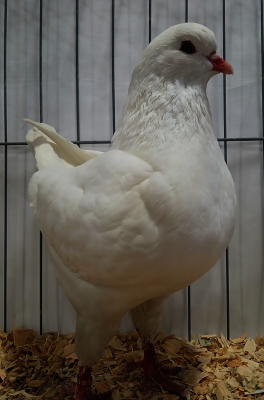
canned squab So, one side of Harry needed a squabber, and the other, elegance and grace. From 1890 to 1892, he very deliberately chose a few of the available breeds for his palette. The exact composition of that palette has been lost to antiquity, but all sources agree that the Homer was one, selected for vitality and fertility, the Maltese for its compact chicken-type form, the Roman or Runt as it is often called for size, and the Duchess for that all important element, elegance. Harry choose only pure white specimens for his creation. This decision was made in part to satisfy the squab's marketability, and also for show considerations. The squab market demanded only white-skinned animals, and since many colored pigeons have darker colored skin, the colored pigeons were dropped from the palette. Also, setting a particular color pattern can take many generations, and Harry, it seems, was in a hurry. While he may have had strong desires to create a show bird, a par-excellence squab producer was clearly the primary target, and he did not miss. By 1892, just two short years later, Harry was so pleased with his results that he called them the King of Pigeons. From that name, I believe Harry could have found a career in advertising. They were prolific, white-skinned, cobby in form, and around one pound in weight dressed at four weeks of age. While they were certainly not up to the standards we find today, they were the perfect squabbing breed for the day. Life sometimes has a way of forcing us to retreat from our loves and Harry had to let go of his White Kings. In 1895, Harry disposed of his flock to local area fanciers, William McMahon and Harry Troth. |
 |
|||
| But it was not McMahon or Troth that really projected the Kings onto the
world stage. That was done by the Giroux brothers. They understood the worth
of this new breed and invested heavily. Within but a few years, they had
the largest squab producing plant in the United States. The White King Squab
Company produced thousands of young per year.
|
||||
| On the other side of the world, well, California, another squab breeder
threw his skills into the creation of Kings. It was just after the turn of
the century that a man, coincidentally named King, started his project to
develop Kings, but of a silver rather than white
color. C. Ray King used basically the same stock as Harry Baker, consisting
equally of Homers, Maltese, Mondaines, and Runts. The Duchess was missing
from his stock, and this is probably the germ that led to more blocky examples
being developed on the West Coast than on the East. By 1921, the Silver King
had become common on the West Coast of the States, and at the fifth annual
show in Oakland, California, the White King Association accepted the new
color class and changed its name to the American King Club to accommodate
the new addition. In just eleven more short years, because of dedicated breeders
whose names I do not know, four more color classes, the Blue, Dun, Red and Yellow Kings were brought
into existence .The King today remains one of the most popular show birds in the States and abroad. It is found in even more colors and patterns than those currently noted in the National Pigeon Association standard, including the popular Andalusian. And undoubtedly, out there somewhere, a few dedicated, enterprising breeders will borrow a gene from another breed and develop even more colors and patterns for the King to wear. Long live the King. |
||||
Gallery |
||||
Standards |
1956 | 1993 | 2000 | 2025 |
 |
|
|
|
|
.png)