


The Breeds of the United States If you have been around these pages awhile you may well come away with the assumption that all of the breeds today are steeped in exotic and rich European or Middle Eastern ancestry. It was commonly believed, before Charles Darwin, that many if not all of these numerous classical breeds were indeed different species as are Robins and Crows. Darwin demonstrated to the contrary that all of the domesticated breeds of what we now term pigeons are all actually derived from one single source, the Rock Dove.It was the persistent, skilled and lucky breeders of the centuries past that brought us the incredible number of wonderful old breeds. Over 800 of these old breeds are still providing amusement and affection throughout the whole world. But just as in the centuries before us, serendipity coupled with persistent and skillful breeding continues to provide us new, beautiful birds. Even if few of these new breeds have been created in the United States where the progenitor of all of the breeds, the Rock Dove, was unknown. lthough new to the pigeon game, America, can boast several unique breeds that were developed over the past 100 years. The earliest and the most recent American creations were both white-colored breeds. The White Kings were crafted just over 100 hundred years ago, and the newest masterpiece of the breeder's skill, the Seraphim, nicknamed the white angel, was created in this decade. These are not the only two breeds originating in the States. There have been several others, including some that have already disappeared from the pigeon fanciers' world. |
|||
Breed Highlight links for more information about the specific breed |
Standards |
||
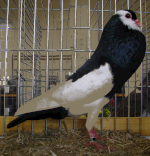 |
The American Bohemian Pouter was developed in the Minnesota area from old style Steller pouters from Bohemia |  |
|
 |
The American Roller was developed in Oregon. It is a variation of the Birmingham type | |
|
 |
|
||
 |
The American Giant Crest was developed in the 30's. Eric Buri was part creator and full the champion for this breed |
|
|
 |
One of just a few truly "American" breeds, the American Giant Homer was first recognized as a distinct breed by the NPA (National Pigeon Association) at the 1928 Grand National Show. The breed is the result of an attempt by early breeders of squabbing homers to improve their breed both commercially and aesthetically. | |
|
 |
The American show racers began being crafted over 100 years ago, and it's another masterpiece of the American breeder's skill in cultivating to an ideal. Racing ability was traded for pure form. | |
|
 |
|
||
 |
The American Giant Rumbler was created by H. Eric Buri, and Wesley Conover in the early 1950s and 60s. It was developed by crossing the English Long-faced Tumbler and the Giant Runt, | |
|
 |
H.P. Macklin started developing the Saint from the Main (Schmalkaldener Mohrenkopfs), Moorhead and Jacobin in the late 50's through the early 60's | |
|
 |
The Seraphim is indeed the most recent serendipitous creation, and its creator,rather than being long gone, still roams among us. This breed is one of the latest creations developed in the United States. |
|
|
 |
The Texan Pioneer, another truly American breed, was created by Del James during the late fifties and early sixties. It is a large breed, similar in size to the French Mondain, which was used in its creation, and the American Giant Homer. It was in the Form class for 2025 the NPA standard. |
|
|
|
|||