


The Breeds of the Pouter and Cropper family Pouters and Croppers are two rather distinct family branches in the pigeon family. They all share a rather enlarged crop that they blow up while cooing and strutting, but other than that they are a very diverse group found and developed all over the world. They are some of the earliest breeds that are mentioned in some of the earliest English language books dating back to early 1800's. They now vary considerable in size, shape, color, behavior and yes, even performance. A few even have very unique flying style that differentiates them within the family. |
||||
Breed Highlight links for more information about the specific breed |
Standards |
|||
|
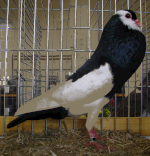 |
The American Bohemian Pouter was developed in the Minnesota area from old style Steller pouters from Bohemia |  |
|
Images of other breeds |
Do you have information you can share about these breeds? |
|||
 |
The Voorburg Cropper is a fairly new breed by pigeon standards, being "created" in 1935 by Theodore Van Gink of the Netherlands. It was made by selective crossing of several other breeds, including the Norwich Cropper, Pigmy Pouter, Brunner Pouter, Swing Pouter, Smerle, and Shield marked Toy Pigeons. |
|
||
 |
The Saxon Pouter is a medium sized, muffed pouter with upright stance and gorgeous color. Originating in the German state of Saxony the color most often associated with the Saxon is Isabel (see photo by following link), which is a light creamy yellow with white bars. The color is to be uniform over the entire body. The only white allowed on Saxons is white barring. The Saxon Pouter exists in the U.S. but only a moderate number of supporters. | |||
 |
A fairly recent addition to the pouter family is the Bavarian Pouter. Developed in the German state of Bavaria by Karl Zausinger in the late 1950s and early 1960s this unique breed bears a strong resemblence to the Hana Pouter and Saxon Pouter. Differences are a less developed foot feathering and the white flighted gazzi marking found on all Bavarians. The list of colors found in the Bavarian is quite extensive with most colors being available. | |||
 |
You can see the pouter/cropper family trait here again in the Pomerian Pouter--the neck blown up into a large balloon. But there are a more than a few differences between the Voorburg Cropper and the Pomeranian Pouter. The two most noticable are the markings and the feathering on the feet. This pouter variety originated in the Pomerania section of Germany. It is a direct descendant of the Dutch Cropper and was developed by breeders who favored longer legged pouters with an upright carriage. |
|
||
 |
With the Pigmy we have a bird that is more friendly and sociable than any other; a bird whose individual points are possibly more numerous than those of any fancy pigeon, and one that, when judged, has to go through its paces in the walking pen, and stand or fall by the way it carries itself before the judge. | |||
 |
The Brunner is the smallest of the pouter family. Originating in Czechoslovakia it is very fine boned, has a delightful personality, can be bred in a wide variety of colors, and is clean legged. The globe (inflated crop) should be round on the Brunner giving nearly the appearance of a ball on a stick | |||
 |
Ghent
|
|
||
 |
Hanna |
|
||
 |
Holle | |||
 |
Elster | |||
 |
Norwich | |||
 |
Reversewing | |||
 |
Old Holland | |||
|
||||